Habit Systems
that actually work
From habit stacking to identity-based behavior change — explore the science-backed systems that make consistency effortless and sustainable.
Four pillars of lasting habits
Each system targets a different aspect of behavior change. Learn them all, then apply what fits your life.
Identity-Based Habits
Instead of chasing outcomes, build your identity first. Don't say "I want to run a marathon" — say "I am a runner." Every action you take is a vote for the person you want to become. When your habits align with your identity, consistency becomes natural.
⭐ FoundationThe Four Laws of Behavior Change
Make it obvious, make it attractive, make it easy, make it satisfying. These four levers govern every habit loop. To build a good habit, use all four. To break a bad one, invert them. Master this framework and you'll understand why habits form and how to design them deliberately.
🔬 Science-BackedHabit Stacking
Attach a new behavior to an existing one using the formula: "After I [CURRENT HABIT], I will [NEW HABIT]." This leverages your brain's existing neural pathways to make new habits stick faster. Start with a 2-minute version and expand over time as the chain becomes automatic.
🔗 Highly EffectiveThe 2-Minute Rule
When you start a new habit, it should take less than two minutes. "Read every night before bed" becomes "read one page." The goal is to master the art of showing up. Once you've become the type of person who never misses, it's much easier to build on top of that foundation.
⚡ Quick Start
Build your morning chain
See how habits link together into a powerful morning routine through the stacking technique.
Why stacking works
Your brain is wired to connect actions. Every time you do A then B, the neural link between them strengthens. After enough repetitions, A automatically triggers B without conscious effort.
This is why morning routines are so powerful — each completed action creates momentum for the next. The chain becomes a single compound habit that feels effortless.
I will [NEW HABIT]."
Choose your consistency method
Different frameworks work for different personalities. Explore and find your match.
The Seinfeld Strategy
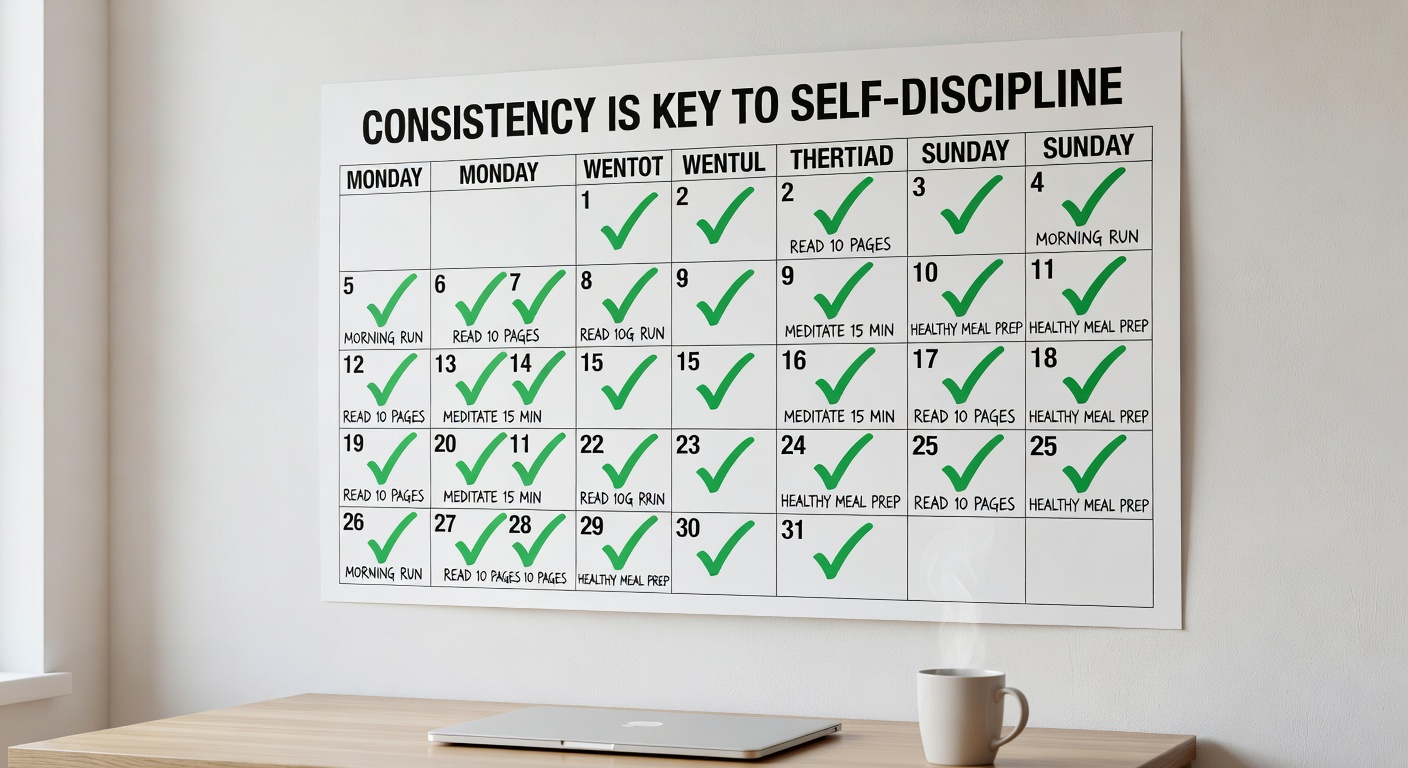
Comedian Jerry Seinfeld's productivity secret is deceptively simple: get a big wall calendar, mark an X every day you complete your habit, and never break the chain. The visual streak becomes a powerful motivator — you don't want to lose your 30-day streak.
This works because it shifts focus from outcomes to the process. You're not trying to write a great joke — you're just trying to put an X on the calendar today.
- Choose one habit to track (start with just one)
- Print or buy a wall calendar and put it somewhere visible
- Mark an X each day you complete the habit, no matter how small
- After 3 days, your only job is to protect the chain
- If you miss, forgive yourself — but never miss twice in a row
The 2-Day Rule
Created by fitness entrepreneur Matt D'Avella, this rule gives you permission to have off days while keeping you honest. Miss one day? Fine. Miss two? Still okay. But you never, ever miss three days in a row.
The genius of this rule is that it removes perfectionism. You don't need a perfect streak — you need a resilient one. Life happens, but the rule creates a hard floor under which your habits cannot fall.
- Define your habit clearly and make it frictionless to start
- When you miss a day, immediately plan the next day's execution
- If you miss two days, the third day becomes non-negotiable
- Track your "two-day events" — they're learning opportunities
- Review monthly what triggered your two-day gaps and adjust
The 1% Better Principle
If you improve by just 1% each day, you'll be 37 times better by the end of a year. This isn't motivational math — it's the power of compound growth applied to human behavior. Small, sustainable improvements beat dramatic overhauls every time.
The 1% approach removes the pressure of huge change and replaces it with curiosity: where can I find one small improvement today? This mindset sustains motivation for years.
- Identify the smallest possible version of your desired habit
- Focus on improvement, not perfection — what's 1% better than yesterday?
- Track your improvements over weeks and months, not days
- Celebrate tiny wins — they're the building blocks of big ones
- Review your 1% gains quarterly to see how far you've come
Implementation Intentions
Research by psychologist Peter Gollwitzer shows that people who plan exactly when and where they'll perform a habit are 2-3x more likely to follow through. The formula: "I will [BEHAVIOR] at [TIME] in [LOCATION]."
By specifying the context in advance, you remove the need for in-the-moment decision making. The decision is already made — your environment becomes the trigger.
- Write your intention: "I will meditate at 7 AM in my bedroom chair"
- Design your environment to make the habit obvious (lay out your mat the night before)
- Pair your intention with a specific situational cue
- Tell someone your intention — social accountability boosts follow-through
- Review weekly and adjust timing or location as needed
Structure your day with intention
Anchor your most important habits to the natural rhythm of morning, afternoon, and evening.
Morning Routine
Midday Routine
Evening Routine
Ready to build your system?
Download our free Habit System Workbook and start designing your routines today.
Get Free Templates → Talk to Us